
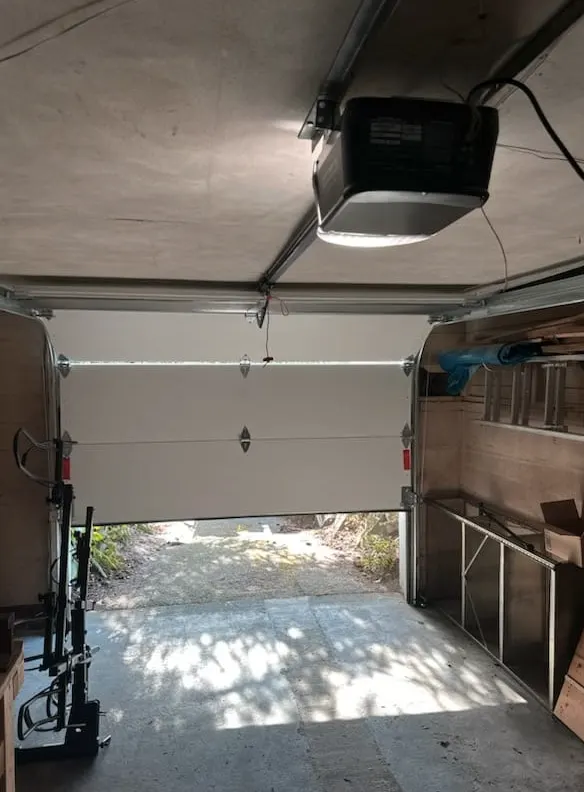
Short answer
The emergency release cord disconnects your garage door from the opener so you can lift it by hand. Pull it when the power is out and you need the car, or when the opener itself has failed and the door is otherwise in good working order. Do not pull it when a spring is broken, when the door is stuck or off its track, or when the door is already partway open and unsupported — in those cases the cord removes the one thing holding the door up, and it can drop fast.
What the cord is actually connected to
Every residential opener has a trolley that rides along a rail and pulls the door up and down. The release cord, usually a red handle hanging from a rope, disengages that trolley from the carriage. Once disengaged, the door is no longer attached to the motor at all — it's just a heavy panel held up by its springs and whatever position it happens to be in. That's the detail most people miss: the cord doesn't make the door safe to move. It just hands control back to gravity and spring tension.
When the springs are doing their job, this is fine
A properly tensioned torsion or extension spring system counterbalances the door's weight so a adult can lift it smoothly by hand after release. This is exactly how the cord is supposed to work during a power outage.
When the springs are not doing their job, this is where it goes wrong
If a spring has already snapped, or has weakened from months of desert heat cycling it through expansion and contraction, the door has little or nothing holding its weight once it's disconnected from the opener. Pull the cord in that situation and a door that was resting at head height can fall straight down. This is the single most common way people get hurt around garage doors — not from the opener, but from manually releasing a door that the springs could no longer support.
Symptoms that mean don't pull the cord
- A loud bang followed by the door refusing to open — that bang is very often a spring letting go. Leave the release engaged and call for spring replacement.
- The door looks crooked or is hanging unevenly — one cable or spring may have failed while the other side is still under tension, which means the door is unbalanced and unpredictable.
- The door is stuck halfway and won't budge — something, often a bent track or a roller jammed by monsoon grit, is physically blocking it. Releasing the trolley doesn't fix the blockage; it just removes the opener's grip.
- You can hear grinding or see the door sagging to one side at rest — a sign of track misalignment that can let the door jump the rail once it's moving freely.
When pulling the cord is the right move
- Power outage, door otherwise healthy — pull the cord, lift the door by hand using both sides evenly, and prop it open if you need it open for a while.
- Opener motor or circuit board failure — if the door operated normally before the opener quit, manual release is generally safe. Lift slowly and check that it moves evenly and stays wherever you let go, which confirms the springs are still balanced.
- Reconnecting after a repair — technicians use the release cord routinely as part of normal service work, always with the door fully down and springs confirmed sound first.
How to pull it correctly, every time
- Make sure the door is fully closed, or fully open and already propped, before you touch the cord. Never release it with the door stopped midway.
- Pull the cord straight down, not at an angle, to avoid binding the trolley.
- Once released, lift the door slowly with two hands at the bottom edge, not the handle, and let go briefly at waist height. A healthy door should stay put on its own. If it drifts up or drops down, stop — that's a spring balance problem, not something to force through.
- To reconnect, close the door fully by hand first, then pull the cord toward the opener until the trolley clicks back into the carriage.
Why this matters more in a desert climate
Torsion springs lose tension gradually, and that process speeds up with the heat cycling that Phoenix garages see — scorching days followed by cool desert nights, over and over, for months. Dried-out lubricant on hinges and rollers also adds resistance that can mask a weakening spring, making a door feel merely stiff right up until it isn't. That's part of why a door that opened fine all summer can suddenly behave unpredictably once temperatures start swinging in the fall and into winter.
When to call Precision Garage Door of Phoenix
If your door banged, sagged, or stopped moving evenly, don't test it further by hand. Precision Garage Door of Phoenix handles spring replacement as a same-system, correctly matched repair rather than a patch job, and we also diagnose opener repair issues so you know whether the problem is the motor or the door itself before anyone touches the release cord. We serve Phoenix, Glendale, Goodyear, Avondale, Tolleson, Litchfield Park, Buckeye, and Peoria.
If your garage door isn't behaving the way it should, call Precision Garage Door of Phoenix today and we'll get a technician out to check it properly.