
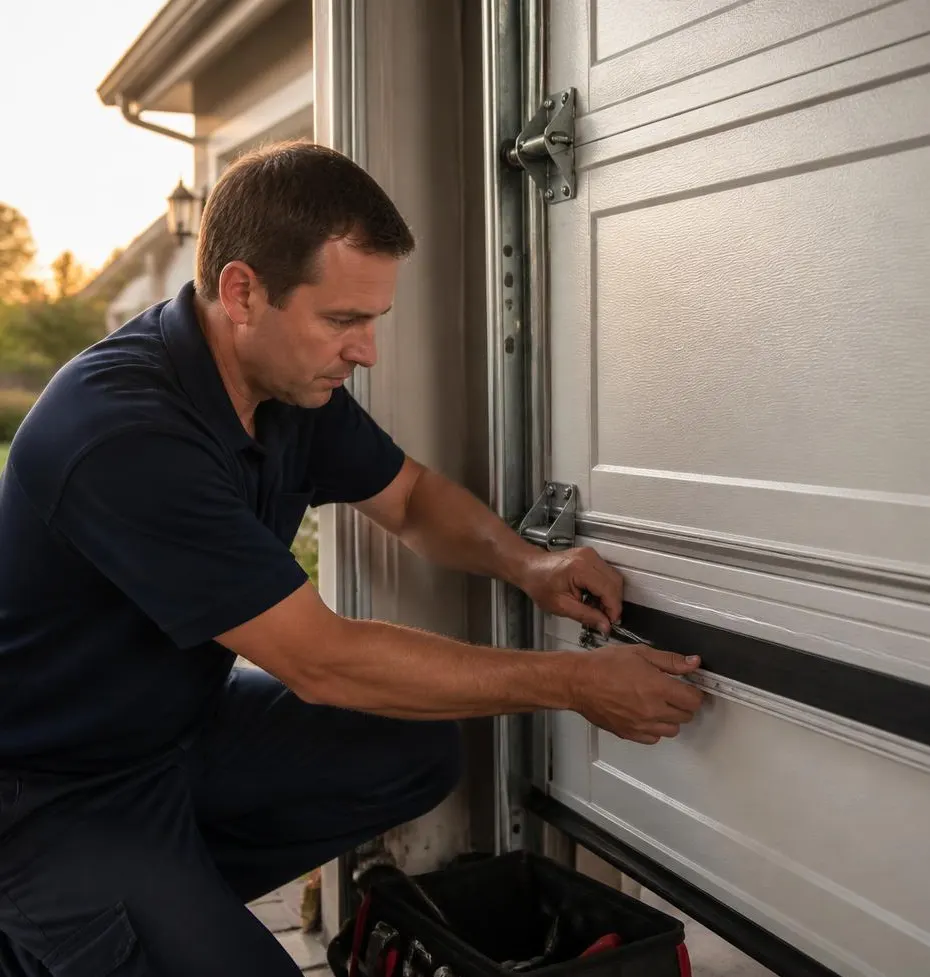
If you do one thing before the next windstorm: open and close your garage door manually, watch the track for wobble or gaps at the wall, and press the auto-reverse test (wave a broom handle under the closing door to make sure it reverses). If the door shudders, the track flexes, or the reversal doesn't trigger instantly, get it looked at before the wind decides to test it for you.
Why the garage door is the weakest wall in the house
Every other opening in a home — windows, the front door — is small and heavily framed. A garage door is a single panel of metal or composite spanning 8 to 18 feet, held in place by thin tracks bolted to the framing and a handful of rollers and hinges. When wind hits the front of a house, pressure builds on that flat surface like a sail. If the door buckles inward, the whole structure can lose integrity fast, because a breached garage often means a breached roofline right above it. This isn't a Phoenix-specific engineering fact, it's just physics — but it matters more here because of what our wind actually looks like.
What late-season Phoenix weather does to a garage door
By October, the hottest stretch of summer has baked everything attached to the door — weatherstripping has gone stiff and cracked from UV exposure, factory lubricant on rollers and hinges has thinned out or burned off from months of heat, and plastic components on the opener have had a summer of thermal cycling. At the same time, the tail end of monsoon season can still throw outflow winds and dust storms through the area even after the heavy rain has tapered off, and nights are starting to cool fast while days stay hot — that swing makes metal expand and contract, which loosens fasteners you haven't checked all year.
Put those together and you get the worst possible timing: a door that's mechanically tired right as wind events are still a real possibility.
A practical pre-storm checklist
- Inspect the tracks. Look for gaps between the track and the wall bracket, bent rail sections, or rust at the mounting bolts. A track that's pulled away even slightly will let the door rack sideways under wind load.
- Check rollers and hinges. Sun-dried lubricant means more friction, which means more strain every time the door cycles. Use a garage-door-specific lubricant (not WD-40, which attracts dust) on rollers, hinges, and the torsion bar.
- Look at the weatherstripping. UV-cracked seals at the bottom and sides don't just let dust and heat in — they're often the first sign that the panel itself has started to warp slightly from sun exposure.
- Test the springs under load. Disconnect the opener and lift the door by hand. It should move smoothly and stay roughly level when you let go halfway. If it slams down or feels unusually heavy, the springs have lost tension from heat cycling and won't hold the door properly in gusty conditions.
- Check the opener's backup battery. Dust storms often knock out power before or during wind events. A working battery backup means the door can still open for your vehicle and close again afterward.
- Verify the auto-reverse safety sensors. Heat and dust buildup on the photo-eye lenses can cause false readings. Wipe them down and retest.
Reinforcement: when it's worth the upgrade
If your door is older or was never rated for wind, a few options exist beyond basic maintenance:
- Horizontal bracing kits bolt across the inside of the panels to stiffen the door against bowing. These are a relatively low-cost retrofit, generally in the low hundreds of dollars as a national ballpark, and work on many existing steel doors.
- Wind-rated replacement doors use heavier gauge steel, reinforced tracks, and stronger end hinges built for sustained pressure. This is the better long-term fix if your current door is already dented, bowed, or more than 15-20 years old, but it costs more upfront than bracing — generally a few thousand dollars as a national range depending on size and material.
- Upgraded track anchors replace standard wall brackets with heavier-duty lag bolts into solid framing, addressing the single most common failure point: the track pulling away from the wall under pressure.
The trade-off is straightforward: bracing kits are cheaper and faster but only as good as the door and track they're attached to. A full wind-rated door replacement costs more but resets the clock on every weak point at once, which matters more if your current door is already showing UV fading, panel warp, or rust at the hinges.
When to call Precision Garage Door of Phoenix
If your door won't close evenly, the track has visible gaps at the wall, a spring has snapped, or a panel is already dented or bowed, don't keep running the opener — that's how a small problem becomes a jammed door mid-storm. Our technicians handle garage door repair for track, roller, and panel issues, and spring replacement when heat cycling has worn out the torsion springs. If you're due for a replacement and want a door actually built for Arizona's wind and heat swings, we also handle full garage door installation with wind-rated options.
Get your door checked before the next storm rolls through — call Precision Garage Door of Phoenix today to schedule service anywhere in the Phoenix metro area.